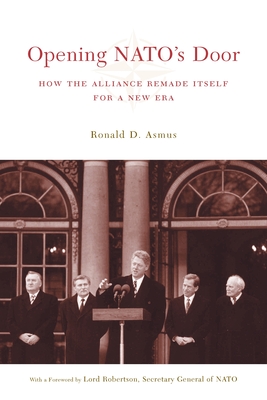
Opening NATO's Door: How the Alliance Remade Itself for a New Era
by Ronald Asmus
In stock, ships in 1-2 business days
Free standard shipping on orders over $40. ISBN 9780231127776
About this book
How and why did NATO, a Cold War military alliance created in 1949 to counter Stalin's USSR, become the cornerstone of new security order for post-Cold War Europe? Why, instead of retreating from Europe after communism's collapse, did the U.S. launch the greatest expansion of the American commitment to the old continent in decades? Written by a high-level insider, Opening NATO's Door provides a definitive account of the ideas, politics, and diplomacy that went into the historic decision to expand NATO to Central and Eastern Europe. Drawing on the still-classified archives of the U.S. Department of State, Ronald D. Asmus recounts how and why American policy makers, against formidable odds at home and abroad, expanded NATO as part of a broader strategy to overcome Europe's Cold War divide and to modernize the Alliance for a new era. Asmus was one of the earliest advocates and intellectual architects of NATO enlargement to Central and Eastern Europe after the collapse of communism in the early 1990s and subsequently served as a top aide to Secretary of State Madeleine Albright and Deputy Secretary Strobe Talbott, responsible for European security issues. He was involved in the key negotiations that led to NATO's decision to extend invitations to Poland, Hungary, and the Czech Republic, the signing of the NATO-Russia Founding Act, and finally, the U.S. Senate's ratification of enlargement. Asmus documents how the Clinton Administration sought to develop a rationale for a new NATO that would bind the U.S. and Europe together as closely in the post-Cold War era as they had been during the fight against communism. For the Clinton Administration, NATO enlargement became the centerpiece of a broader agenda to modernize the U.S.-European strategic partnership for the future. That strategy reflected an American commitment to the spread of democracy and Western values, the importance attached to modernizing Washington's key alliances for an increasingly globalized world, and the fact that the Clinton Administration looked to Europe as America's natural partner in addressing the challenges of the twenty-first century. As the Alliance weighs its the future following the September 11 terrorist attacks on the U.S. and prepares for a second round of enlargement, this book is required reading about the first post-Cold War effort to modernize NATO for a new era.
Details
- Format
- Paperback
- ISBN-13
- 9780231127776
- Publisher
- Columbia University Press
- Published
- August 11, 2004
- Pages
- 372
- Weight
- 19.2 oz
- Subject
- Political Science
Popular in Political Science
Browse Political Science
Blockers: Rebels in the Deep State
Michael Lewis
$23.99

The American Way of Killing: The Invention of an Epidemic
Malcolm Gladwell
$26.99

The Fight Back: A Citizen's Guide to Standing Up to Dictators
Maria Ressa
$23.99

Regime Change: Inside the Imperial Presidency of Donald Trump
Maggie Haberman
$26.99

Wtf America?!: The Way Out of This Hell and Back to Democracy
Ben Meiselas
$25.99

The Counterrevolution: The Fall and Rise of Donald Trump and the Maga Movement
Victor Davis Hanson
$26.99

How to Stand Up to a Dictator: The Fight for Our Future
Maria Ressa
$16.99

On Tyranny: Twenty Lessons from the Twentieth Century
Timothy Snyder
$11.99

Family of Spies: A World War II Story of Nazi Espionage, Betrayal, and the Secret History Behind Pearl Harbor
Christine Kuehn
$15.99

How Russia Won: Donald Trump, Vladimir Putin, and the Fight for America
David Corn
$27.99

Go and Do Likewise: How We Heal a Broken Country
Andy Beshear
$23.99

The Origins of Totalitarianism: With a New Introduction by Anne Applebaum
Hannah Arendt
$17.99