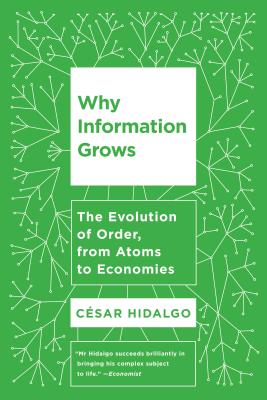
Why Information Grows: The Evolution of Order, from Atoms to Economies
In stock, ships in 1-2 business days
Free standard shipping on orders over $40. ISBN 9780465096848
About this book
"Hidalgo has made a bold attempt to synthesize a large body of cutting-edge work into a readable, slender volume. This is the future of growth theory." -- Financial Times What is economic growth? And why, historically, has it occurred in only a few places? Previous efforts to answer these questions have focused on institutions, geography, finances, and psychology. But according to MIT's antidisciplinarian Cér Hidalgo, understanding the nature of economic growth demands transcending the social sciences and including the natural sciences of information, networks, and complexity. To understand the growth of economies, Hidalgo argues, we first need to understand the growth of order. At first glance, the universe seems hostile to order. Thermodynamics dictates that over time, order-or information-disappears. Whispers vanish in the wind just like the beauty of swirling cigarette smoke collapses into disorderly clouds. But thermodynamics also has loopholes that promote the growth of information in pockets. Although cities are all pockets where information grows, they are not all the same. For every Silicon Valley, Tokyo, and Paris, there are dozens of places with economies that accomplish little more than pulling rocks out of the ground. So, why does the US economy outstrip Brazil's, and Brazil's that of Chad? Why did the technology corridor along Boston's Route 128 languish while Silicon Valley blossomed? In each case, the key is how people, firms, and the networks they form make use of information. Seen from Hidalgo's vantage, economies become distributed computers, made of networks of people, and the problem of economic development becomes the problem of making these computers more powerful. By uncovering the mechanisms that enable the growth of information in nature and society, Why Information Grows lays bear the origins of physical order and economic growth. Situated at the nexus of information theory, physics, sociology, and economics, this book propounds a new theory of how economies can do not just more things, but more interesting things.
Details
- Format
- Paperback
- ISBN-13
- 9780465096848
- Publisher
- Basic Books
- Published
- February 14, 2017
- Pages
- 256
- Weight
- 8.8 oz
- Subject
- Business & Economics
Popular in Business & Economics
Browse Business & Economics
The 7 Habits of Highly Effective People: 30th Anniversary Edition
Stephen R. Covey
$16.99

Extreme Ownership: How U.S. Navy Seals Lead and Win
Jocko Willink
$24.99

Bad Blood: Secrets and Lies in a Silicon Valley Startup
John Carreyrou
$17.99

Die with Zero: Getting All You Can from Your Money and Your Life
Bill Perkins
$16.99

Crucial Conversations: Tools for Talking When Stakes Are High
Joseph Grenny
$19.99

Radical Candor: Be a Kick-Ass Boss Without Losing Your Humanity
Kim Scott
$25.99

1929: Inside the Greatest Crash in Wall Street History--And How It Shattered a Nation
Andrew Ross Sorkin
$27.99

What Could Possibly Go Right?: The Essential Journey to Scale an Enduring Culture
Danny Meyer
$25.99

I Will Teach You to Be Rich: No Guilt. No Excuses. Just a 6-Week Program That Works (Second Edition)
Ramit Sethi
$14.99

Never Split the Difference: Negotiating as If Your Life Depended on It
Chris Voss
$27.99

The Total Money Makeover Updated and Expanded: A Proven Plan for Financial Peace
Dave Ramsey
$23.99

Think Again: The Power of Knowing What You Don't Know
Adam Grant
$16.99